Danielle, 33 - Coventry
Danielle is a healthcare assistant with around eight years in primary care at a GP surgery in Coventry. She trained with wax. to build a mobile ear-care service and twice-monthly Saturday clinic alongside her surgery job. This is her story, in her own words.
“Knowing when not to treat someone is just as important as knowing how to remove wax safely.”
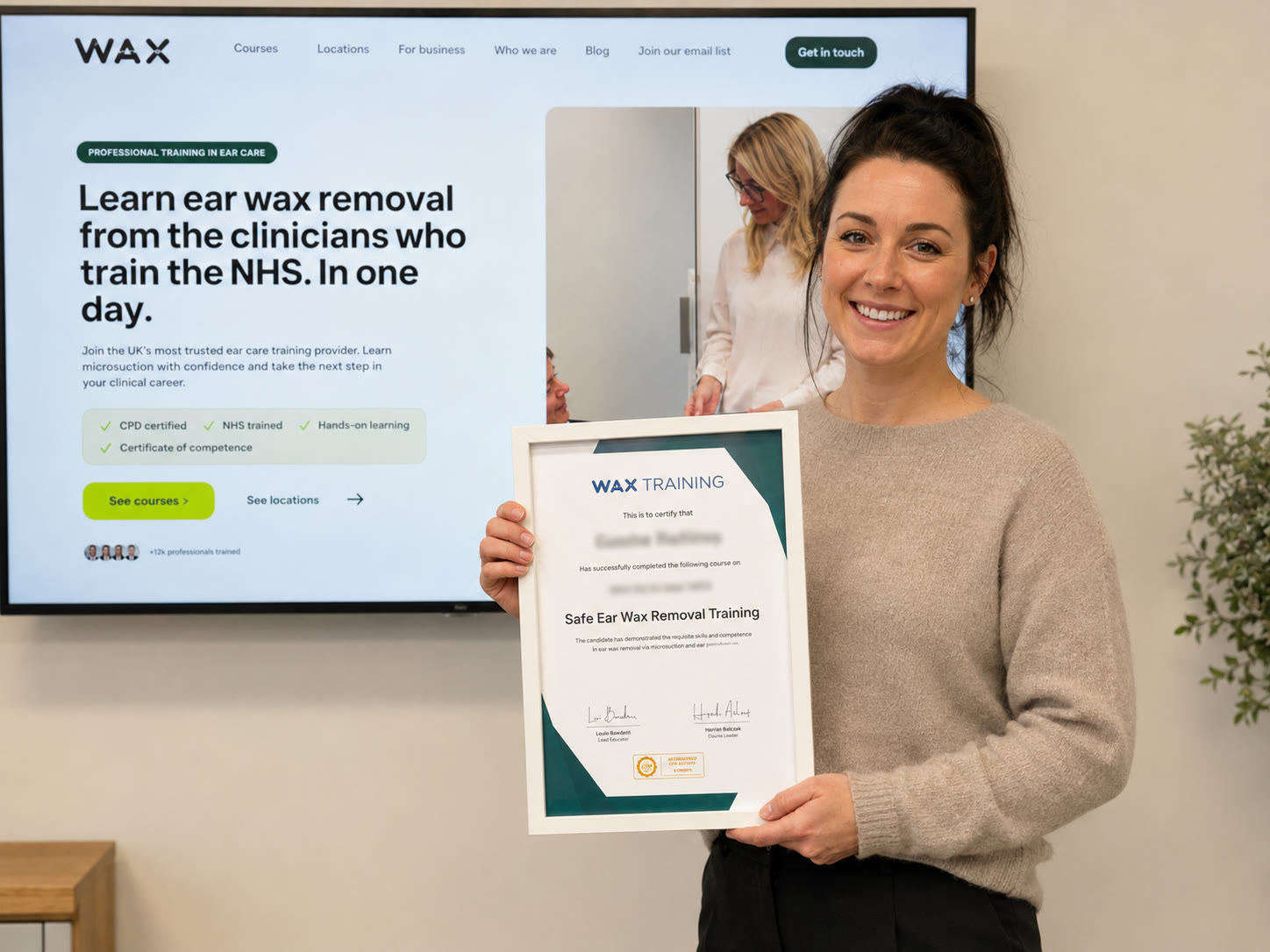
Tell us a little about yourself and your current experience.
I'm a healthcare assistant working in a GP surgery in Coventry.
I've worked in primary care for around eight years and currently carry out health checks, blood pressure reviews, phlebotomy and a range of other patient-facing procedures.
I really enjoy working with patients, but I'd started thinking about whether I could create an additional income using the healthcare skills I already have.
Why did you choose the ear wax removal industry?
It actually came from conversations at work.
Patients regularly asked whether our surgery still provided ear syringing or where they could have blocked ears treated.
When you hear the same question repeatedly, you start to realise there's a genuine gap in the local market.
Ear wax removal also felt achievable for me because it still involves one-to-one patient care, which is the part of my current job I enjoy most.
Why did you choose wax. for your training?
I wanted proper face-to-face practical training.
I was quite nervous about whether my HCA background would be enough, so seeing that wax. trained people from different healthcare backgrounds really reassured me.
The course also seemed to cover the complete process, from examining the ear through to treatment and referrals, rather than simply teaching how to use a microsuction machine.
How did you find the course?
Honestly, I enjoyed it much more than I expected.
I was probably one of the more nervous people at the beginning, but the trainers were really supportive.
Once we started the practical work, everything began to make sense.
Being able to ask questions as you go and practise under supervision made a huge difference to my confidence.
What did you learn?
I learned how to properly examine an ear using an otoscope, recognise normal anatomy and identify potential problems.
We covered contraindications, infection control and when a patient needs to be referred.
The practical training then included microsuction, warm-water irrigation and manual instrumentation.
One of the biggest things I learned was that knowing when not to treat someone is just as important as knowing how to remove wax safely.
Would you recommend wax. training?
Definitely.
I'd recommend it to other HCAs who might be thinking, “Am I experienced enough to do this?”
The course builds on a lot of skills you already have from working with patients and then gives you the specialist knowledge needed for ear care.
I finished the training feeling far more confident about working independently.
What are your plans for the future?
I'm going to start with a combination of mobile appointments around Coventry and a Saturday clinic twice a month.
That lets me test both options while keeping my current GP surgery job.
My aim is to build up slowly through recommendations and local marketing, then eventually have two regular clinic days each week.
For me, the long-term goal is to have more control over my working week and create a healthcare business that is genuinely mine.
Start your own story
One day of CPD-accredited training with NHS-trained clinicians - all three removal methods, live patients, and the business setup to earn with it.
A CPD-accredited provider, aligned with BSA, NICE and HCPC standards. Every course is taught by NHS-trained ear care clinicians and certified for professional development.